About Us

PVOA is an organization based in Loudoun County, Virginia, is a professional member of NASO, and dedicated is to the advancement and development of youth sports.
Showing posts with label Game and People Management. Show all posts

Wednesday, October 18, 2017

Game Management - Get the First Illegal Act


Watch the clip above.  In the span of 13 seconds, we have 2 screens and a shooting foul on a drive to the basket.

Let's break down the play:

  • Is the first screen by Red #21 legal?  It's pretty close and calling it would be putting junk into the game.  
  • Is the second screen by Red #231 legal?  Definitely not.  Red #231 moved into a defender and did not give the defender time and space to avoid contact.
  • Is the foul by White #44 accurate and right?  It's close and an argument can be made either way on the contact.
The point of this video is to bring out two points:
  1. Officials must work to get the first illegal act instead of penalizing the subsequent action.  In this play, a team control foul for an illegal screen should have been called on Red #231.  White should have the ball to inbound on the sideline.  Instead, a shooting foul is called on White #44 which puts Red #10 on the line for possible 2 points.
  2. Do not make the game harder for yourself.  If the trail official in this case was refereeing the defense, then that illegal screen would've been really easy to call.  Instead, the crew exchanged an easy call for a much tougher call to make.
Much easier said than done, and that's why officials must referee the defense and avoid getting tunnel-vision.

This is a case study in game management: understand that as officials, we should always work to get the first illegal act and not punish the second act.  Coaches tend to get upset when an official's missed call results in a possible scoring opportunity for the other team.  

Monday, October 16, 2017

Game Management - Understanding the Ramifications of Your Whistle (3 seconds)


Watch the clip above.  #4 for North Carolina starts out in the lane at :01 of the video and continues to be in the lane at :06 when the ball is released for a successful 3-point try.

He's in the lane for a total of 5 seconds.  But wait, isn't it a 3-second violation if an offensive player remains in the lane for more than 3 seconds?  Did the officials miss this one?

As basketball officials, we need to understand the ramifications of our whistles.  Every time we decide to put air into the whistle, we are affecting the game.  Therefore, we should careful pick when we insert ourselves into the game.

In this clip, Duke had just scored a successful 3-point try to pull within 1 point of North Carolina with a little under 9 minutes to play in the 1st half.   

While #4 did satisfy the conditions for a 3-second violation, ask yourself these questions:
  • If there is a good flow to the game (it is a fast-paced competitive game), is this the right opportunity to disrupt the flow with a 3-second call?
  • Was #4 every involved in the play?
  • Did #4 gain an advantage from being in the lane for a prolonged amount of time?
#4 was never involved in the play so never gained an advantage from being in the lane.  Making this call is not only a turnover at this point, but also taking potential points away from North Carolina.    The correct call in this situation would be a no-call.  

However, had the ball been passed to #4, then an advantage has been gained by #4 being in the lane for a prolonged amount of time.  Therefore, that would justify a 3-second call.

Just because a call is accurate, does not mean the call is right.

In this type of situation, if the coach asks: "Hey, can you keep an eye out in the lane for 3-seconds?"  The response should be: "Coach, I saw him in there, but he was not involved in the play."

This is a case study in game management: understand that there are ramifications for every whistle.  Coaches tend to get upset when officials (1) make a marginal call that gives the opposing team an opportunity to score points or (2) officials make a marginal call that takes points away from their team.

Monday, November 17, 2014

Let's Talk About the Pre-Game

(Image Source: NCAA.org)


Starting the Game Off Right

Basketball is arguably the most difficult game to officiate.  Contact is unavoidable when we put 10 players in an enclosed space.  Contact can occur all over the floor, both on the ball and away from the ball.  Combine that with the speed of the game and what we have is a recipe for disaster if the officials are not on the same page.

NFL football referees work in crews and they have the benefit of building teamwork and camaraderie through working numerous games together.  As basketball officials, we do not have that luxury as we are constantly working with different partners.  So how do we make sure that we are on the same page during the game and will call the game with the respect that it deserves?

Here enters the all important pre-game meeting. 

Officials should arrive at the game at least 10-15 minutes prior to the start of the game (or more if the level of game dictates it).  This leaves plenty of time to conduct a pre-game meeting between the officials.


Who's the Lead?

The "Referee" (as opposed to the "Umpire") is responsible for leading the pre-game meeting.  In games where there is no clear marked "Referee", both officials are equally responsible in leading and contributing to this meeting.


Topics to Cover

  • Teamwork
    • Partners should establish and maintain communication
      • Make sure all officials are ready before inbouding the ball
      • Communicate if fouls are shooting or spot fouls
    • Responsibilities during timeouts
      • Who is reporting the timeout?
      • What is the remaining official's responsibility?
    • Responsibilities during dead ball situations
      • One official is responsible for inbounding the ball
      • The other official is responsible for any substitutes
    • End of quarters/halves/game
      • Who is responsible for watching the clock
  • Consistency
    • Be consistent in enforcement of fouls and violations
    • Get the obvious fouls and violations
  • Safety
    • We have to protect the players
      • Get the obvious and make sure the game doesn't get out of hand
      • If there's an advantage gained because of an illegal contact, let's get the foul
    • Foul Absolutes (Should always be called a foul)
      • Two hands on a player
      • If the dribbler's rhythm, speed, balance, and quickness is affected
      • If the dribbler falls down because of contact
  • Coverage
    • Let's make sure that we're both not ball watching
      • Try not to call fouls/violations on plays that occur right in front of your partner
    • 3 seconds
      • If the ball is in the corner in the Lead's area of coverage, the Trail referee is responsible for the 3-second violation call
      • If the ball is in the Trail's area of coverage, the Lead referee is responsible for the 3-second call

Conclusion

Do not underestimate the importance of the pre-game meeting.  No matter how many times the officials have worked together, a pre-game meeting should still be conducted before every game.

If anything, remember to talk about the importance of teamwork, consistency, safety, and coverage.
  

What do you talk about during your pre-game?  If you have any other pre-game notes that you would like to share, please feel free to leave a comment.

Monday, November 10, 2014

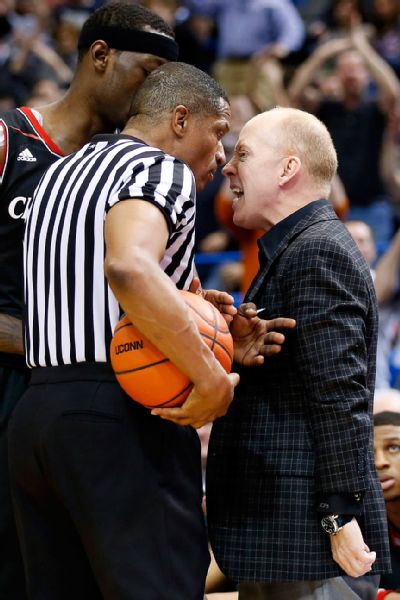
"I hear you, Coach."

James Dickey
(Image Source: ESPN.com)


"What we've got here is a failure to communicate." (Cool Hand Luke, 1967)


Today's post is a Part 2 followup to last week's post regarding how not to argue (you can read that post here).  In that post, I linked a Referee.com article written by a psychologist with a list of points on what not to do in an argument with a Coach.

Part of being a successful referee is your communication skills: your nonverbal and your interpersonal.  As a referee, it's our job to enforce the rules and to make calls when the rules of the game are broken.  Every time we fill our Fox 40 with air, the game stops, at which point every head in the gym/stadium turns to you to see what call you are going to make.

Is it a violation?  Did somebody get fouled?  Maybe one of the coaches called a timeout?

What we do next tells everybody what we have.  If it's a foul, we raise our hand with a closed fist.  If it's a violation, we raise our hand with an open palm and then indicate the violation.  If it's a timeout, we raise our hand with an open palm and point to the bench with a verbal "timeout!" call.  When these are not done, the fans, players, and coaches (and your partner!) are left scratching their heads as to what the call is.

What if the ball goes out-of-bounds and your partner starts beckoning substitutes into the game.  If you don't communicate with your partner (via eye contact, etc) and you put the ball in play now we have a situation where players are transitioning into and out of the game.

Communication is important and if we don't pay attention to our communication...what we have left is a failure to communicate.


"I hear you, Coach."

What about our interaction with coaches?  We already know how not to argue with them; how do we practice a little bit of "preventative officiating" and avoid those potential arguments and conflicts?

Interacting with coaches at the scholastic (high school) and higher levels are vastly different than interacting with your moms and dads who come out on the weekend to help coach Junior and Sally's team(s).  Your coaches at the high school level and above are paid professionals.  Your recreational level coaches are unpaid volunteers.

Just as we have different standards to calling a scholastic vs. recreational game, our interactions with the coaches at these two different levels must be different.  We have to be more patient with coaches at the recreational level because they are volunteers - they are not paid and more often than not, they do not know the rules.

You want examples?  How about the infamous 3-second violation.  We all know that this count resets every time the ball is shot, but how many times do we hear coaches yell "He's been in there for 10 seconds!"

Or how about "over the back".  We all know there is no such call as "over the back" and unless there's displacement, there is no foul, but we still hear coaches yell "He's going over the back for that rebound!"

But nothing irks a coach more than when his players are getting fouled and calls are not being made.  Remember that coaches are always going to advocate for their players.  If there is a big crash on a layup attempt and poor Johnny hits the deck, but no whistle, that coach is going to want to know why there wasn't a whistle.

If the coach has a legitimate question and asks it in a professional manner, we must provide a legitimate answer.

Sometimes, all they are looking for is to know that you are keeping an eye out of it.  A simple "I hear you, Coach and I'll keep an eye out on it." can do wonders for your interaction with that coach on that particular game day, not to mention diffuse a potentially explosive situation.

If you missed a play, you missed it.  We are human so we all makes mistakes and there has yet to be a perfect game called.  In the situation where there was a crash and you missed the call, when questioned about it, just say "You're right Coach, I missed it."  If there was an obvious foul and no whistle and we don't admit that we were wrong when questioned by the Coach...we end up losing credibility.

As NBA referee Joey Crawford says: "You are wrong sometimes.  It doesn't mean that you are wrong on purpose, but you are wrong sometimes, and you have to admit when you are wrong."

Ignoring a Coach who has a legitimate complaint is never the right way to go.  Depending on the style of play during the game, the Coach's frustration may continue to rise to the point where there is now a full blown argument and we start throwing out Technical fouls.


Closing Thoughts

There is the thought that Coaches and Referees must be adversaries and oppose each other, but that is not true.  For our recreational level games (games where scholarships aren't on the line, players aren't being paid, etc), coaches and referees must work together to lead the players.  When that balance is achieved, the players and the game benefits.

This means that Coaches should be allowed to voice their concerns with the Referees (respectfully, of course...meaning without accusation, screaming, or being aggressive) and the referees should take a moment (note: a moment only!) at a reasonable time during the game to address these concerns.

However, this does not mean the Coach has the right to say anything he/she wants to say and this does not give the coach an opportunity to verbally abuse or degrade the game official.  If the line has been crossed between open communication to one of verbal abuse, we need to nip that in the bud and re-establish that line, whether it be a verbal warning or a technical foul.

The common complaint that I hear from coaches regarding an official's interpersonal communication is that the official "is not open for dialogue."  When this happens, the us vs. them mentality is established and that is a ticking time bomb.

I leave you with this: our relationship and communication with coaches, while tricky, should be one of professionalism and born out of respect for each other.  If we establish that open dialogue, it will go a long way on any given game day in helping us avoid conflict with coaches.


Of course, if you do get into an argument, click here to learn how not to argue.

Tuesday, November 4, 2014

"I love argument, I love debate."

(Image Source: ESPN)


Anatomy of an Arguement


The former Prime Minister of the United Kingdom, Margaret Thatcher once said in an interview in 1980, "I love argument, I love debate.  I don't expect anyone to just sit there and agree with me , that's not their job."

While we all know someone who starts arguments just for the sake of starting an argument, I believe that to a certain degree, all of us "love argument" and "love debate".  Maybe it's because we are able to voice our opinion or prove our point.  Maybe it's because we just want to win.

As basketball referees, there's nothing that gets the blood going more than the anticipation of having a heated debate with a coach over a call (or calls).  As imperfect creatures, when met with fire or hostility, more likely than not, our first instinct will be to push and fight back.

How Not to Argue


But what should we do in a profession where we are asked to remain above the fray?  When more often than not, it's not what an we do as an official that gets us in trouble, but rather what we say.

Referee.com has a great article regarding how not to argue.  Psychologist and author Peter Sacco lists seven (7) great points to keep in mind when managing an argument.  You can read the article here.  The link is also posted below:

http://www.referee.com/how-to-not-argue/

Conclusion


As officials, we need to work hard to remain above the fray.  While coaches deserve a legitimate answer if they have a legitimate question, do not allow them to use this time to question your game management or calls you've made in the game.  Defuse potential problems quickly and move on and never go looking for trouble.  However, do not let this be the reason that you allow a coach to be out of control - do not be a rug for them to walk on in your attempt to avoid conflict.

Lastly, always remember that in our interaction with players and coaches in this day in age, there is always the chance that we will be video taped.  Eye-witness statements can even be wrong when fans and spectators attempt to "interpret" our body language and actions.  Let's carry ourselves as officials in an manner that is professional and becoming of the uniform that we wear.

Example


Last season , there was an unfortunate situation with a coach that got out of control.  Our officials on that game handled the situation with composure and professionalism.  The week after, I received the following praise from one of the parents who witnessed the whole incident.

"During the game, the [coach] got very agitated and started yelling at the [referee] to make a certain call.  He berated [this official] while [the official] tried to ignore him.  Finally, [the official asked], “Coach, I have to ask you to calm down and step back.”  He continued to yell and now began to follow [the official] around the court.

This whole time, the [officials] maintained [their] cool.  [They] never raised [their] voice or looked frazzled.  [They] did not try to intimidate the coach.  [They] did not assert [their] authority in any way.  I was amazed at [their] composure.  They did not gang up on the coach or even appear to be stressed themselves."

While I personally believe that this coach deserved the Technical after he started yelling at the officials, the composure of the officials on the court during this heated exchange is commendable.  Had the officials reacted differently, the outcome (and the e-mail that I received) could have been very different.

As the Referee.com article says: "It takes a minimum of two people to have an argument. If one person chooses not to participate, that leaves the second party blustering in the wind."